


Motor Vibration Test Platform
Contact Info
- Add:, Zip: 061000
- Contact: 谢佳宁
- Tel:15350773479
- Email:3622313939@qq.com
Other Products


Installation Methods and Pre-installation Work for Large Cast Iron Platforms
The casting process of large cast iron platforms can be divided into three 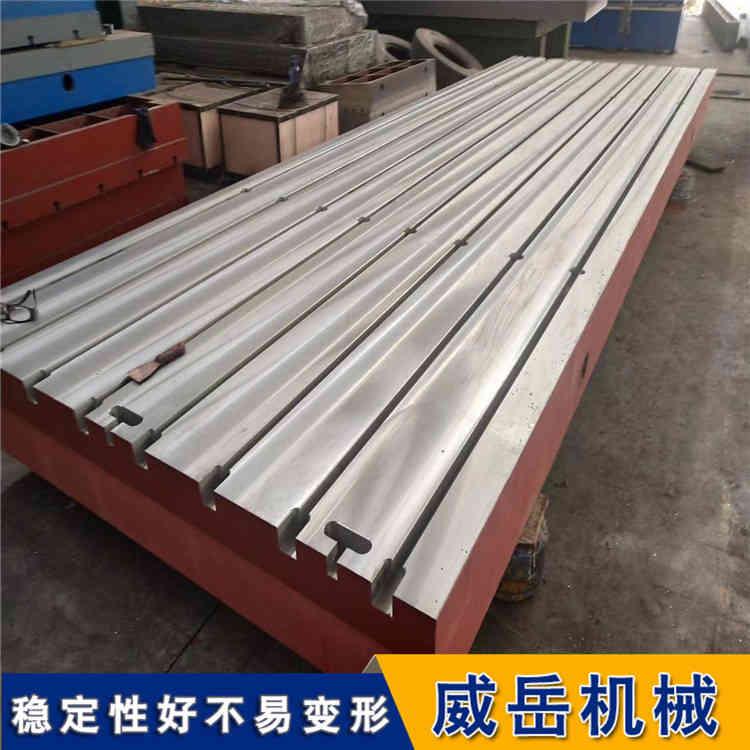 basic parts: preparation of casting metal, mold preparation, and casting treatment. Casting metal refers to the metal material used in the production of large cast iron platforms for pouring castings, with elements as the main components, and alloys formed by adding other metal or non-metal elements, commonly known as casting alloys, mainly including cast iron, cast steel, and cast non-ferrous alloys. What are the causes of cracks in riveting platforms: Temperature range for crack formation: There has long been disagreement about the exact temperature at which hot cracks in investment castings occur. Hot cracks in large cast iron platforms form within the solidification temperature range but close to the solidus temperature, when the alloy is in a solid-liquid state. Cracks in large cast iron platforms form slightly below the solidus temperature when the alloy is in a solid state.
The gas evolution of molding sand is between 17~20 ml/g. The height of the upper box or pouring cup is too high, the static pressure of the molten metal is high, and the improper setting of the gating system and riser causes local overheating of the mold and casting, leading to sand sticking. This results in damage to the large cast iron platform, with adhered sand having high clay content, high moisture, high coal dust content, and high gas evolution. Poor ventilation conditions in the sand mold, overly fast pouring speed, and high gas evolution from the sand core of the large cast iron platform contribute to the issue. Sand cores made with coated sand have higher gas evolution compared to resin sand cores. Additionally, the degree of curing of the sand core affects its gas evolution. Moreover, the coating on the surface of the sand core also has significant gas evolution. Since the sand core may crack if coated when too hot, it is necessary to wait for the sand core to cool appropriately before coating, and it is difficult to ensure the coating is fully dried.
Excessive viscosity causes gas卷入 during pouring and filling, as well as gas析出 from the molten metal, which is expelled from the mold or rises to the riser or vent. An unreasonable gating system for large cast iron platforms, overly fast pouring and filling speeds, and poor venting of the metal mold cause turbulence, vortex, or breakage during pouring and filling, leading to卷入性 porosity in the castings. This is primarily due to casting process characteristics (hot cracking tendency, fluidity, and shrinkage, etc.). If the material has a high tendency for casting process issues, the rejection rate due to hot cracks in large cast iron platform castings will be high. Additionally, low-melting-point inclusions distributed along the grain boundaries of cast steel reduce its strength and plasticity. As the number of inclusions increases, strength and plasticity decrease, promoting the formation of hot cracks. During the melting of large cast iron platforms, clean and pure charge materials should be selected, and reasonable melting processes should be adopted, with strengthened operations to ensure quality.
The grain size of molding sand and core sand for large cast iron platforms is too coarse, with low clay content and ash content in the molding sand. The gaps in the mold (sand core) are large, and the resistance to metal penetration is low. The grain size of workshop molding sand is 50/100 or the average fineness is between 50~57. Coated sand grain size is 50/100 or 100/50, with an average fineness between 49~55 for large cast iron platforms. The raw sand for large cast iron platforms is coarser than that used in general green sand molding processes, with the type ranging between 130~170.
The alloy melt for large cast iron platforms is prone to gas absorption. Without refining, protection, and purification measures during melting and pouring, the molten metal contains a large amount of gas, slag, and air inclusions, forming析出 porosity and reaction porosity during molding and solidification. Improper preparation of molding sand, cores, and coatings leads to interface reactions with the molten metal, forming surface pores and subcutaneous porosity in large cast iron platforms. When melting gas-absorbing alloys in certain seasons, the alloy melt absorbs a large amount of gas, causing batch rejection of castings.
Moreover, rare earth elements can refine the grain, change the morphology and distribution of inclusions, thereby reducing the size and depth of hot cracks in large cast iron platforms and decreasing the number of hot cracks. Reasonable material selection is a complex technical and economic issue.所谓 reasonable material selection means that the material chosen for large cast iron platforms should meet the requirements of usability, processability, and economy for the parts. For castings,
Weiyue Machinery, Ms. Xie, 15350773479
| Industry Category | Machinery & Equipment/Commercial Equipment/Bag Closing Machines |
|---|---|
| Product Category | |
| Brand: | 威岳 |
| Spec: | 2000*4000 |
| Origin: | 111309 |


